

By 2030, Millennials and Gen Z will make up nearly three-quarters of the global workforce. Over the past decade, leadership teams and HR departments have spent endless hours trying to figure them out. Still, nothing quite prepared the corporate world for what happened between 2020 and 2025 - a five-year stretch that fundamentally flipped how this younger workforce thinks, lives, and defines the role of work.
Back in 2020, right in the middle of a global crisis, Deloitte published a study called The Resilient Generation. It captured a portrait of young people weathering a storm: bearing the brunt of sudden downturns, patiently bending to new rules, and holding on to their jobs for a sense of shelter.
Five years down the road, Deloitte’s 2025 Global Survey - spanning over 23,400 people across 44 countries - tells an entirely different story. That willingness to simply put up with things is gone.
If you are earning a living today, or carrying the responsibility of leading a team, this five-year shift is not just another deck of corporate data. It is a mirror held up to what we actually value - and how we choose to spend our days.
1. The 2020 Starting Point: “The Resilient Generation” in the Eye of the Storm
To understand where younger professionals stand today, we need to take a step back to 2020. That was the moment a global health crisis hit, triggering a domino effect across the world economy. Deloitte’s 2020 study tracked how nearly 27,000 young people responded across two distinct waves - just before the outbreak and right in the thick of it. What surfaced was a mindset anchored in three distinct pillars:
Financial Defense and the Loyalty Dilemma
Entering adulthood after the 2008 downturn left Millennials already uneasy about money. The 2020 lockdowns hit them with another setback: Gen Z employment dropped by a third, while Millennials lost 16% of their jobs in just the first two months.
Facing that reality, they tightened their belts. Survey numbers showed them saving or investing around 40% of their leftover pay, putting an end to the idea that younger people just waste money. The shock made job security so important that, for the first time in years, the number of young employees wanting to stay with the same company for over five years went way up. They were willing to settle, just to keep their footing.
Climate Change: A Non-Negotiable Moral Line
Even with their daily bread on the line, climate change stayed at the very top of what worried this generation long-term. Those worldwide lockdowns turned into an unplanned real-life experiment: with factories idle and planes grounded, city skies cleared up and waterways turned clean again.
Seeing that happen gave them a clear takeaway: the damage to our planet can actually be turned around if people take real, collective action. From that point on, they started looking closely at how honest businesses really were. They began asking for hard proof and real numbers behind corporate promises, refusing to just sit back and take greenwashing at face value.
Prioritizing Mental Health First and the Rise of Remote Work
Before 2020, nearly half of young workers dealt with constant, high-level stress. But in the months that followed, Deloitte’s numbers picked up something unexpected: stress levels actually went down across several areas of life.
Working from - home which 60% wanted to keep doing even after restrictions were lifted - freed them from packed commutes, trimmed daily expenses, and let them be themselves instead of putting on a corporate act every day. Still, that relief was more of an immediate shield than true, lasting balance.
The takeaway back in 2020 was straightforward: younger workers were doing everything they could to adjust. In return, they wanted stability, fair treatment, and workplaces run by people who treated them like human beings.
2. The 2025 Reality: Moving From Coping to Setting the Rules
After five years of relentless pressure - persistent inflation, geopolitical uncertainty, and the sudden rise of Generative AI - the 2025 data shows that how younger people view work has fundamentally changed:
Redefining Success
One of the most striking findings in the 2025 report is this: only 6% of Gen Z see climbing into senior management as their main career goal.
This is not a lack of drive; it is a complete reset of what success actually looks like. Rather than trading their health and personal lives for an impressive title - one that usually comes with chronic burnout - they are holding out for a balanced trifecta: Money, Meaning, and Well-being. To them, these three are inseparable. Without financial stability, work loses its sense of purpose; and when mental health falls apart, no mission feels worth the cost.
Exercising the “Veto Power”
The days of the quietly compliant employee are over. By 2025, more than half of younger professionals state that they are ready to turn down an assignment - or even walk away from a job offer - if a company runs counter to their personal values on environmental responsibility, diversity, or ethical standards.
Over 90% point to a sense of purpose as a non-negotiable condition for staying put. Young workers no longer treat employment as a favor handed down from above. They see it as a two-way partnership, and one that comes with clear boundaries.
The Cost-of-Living Squeeze
In 2020, young people believed that tight personal budgeting would see them through the downturn. By 2025, persistent inflation forced a harsh reality check. Nearly half of those surveyed - 48% of Gen Z and 46% of Millennials - admitted to living with constant financial anxiety.
With paychecks falling behind everyday expenses, many felt they had no choice but to take on side gigs, picking up freelance work on digital platforms or building extra income streams just to create a basic safety net. This lingering worry over everyday bills is directly eating away at their peace of mind and their focus in their day jobs.
The Reality of GenAI and the Return to Human Value
The vague anxiety about automation from years past became an everyday reality with the rollout of Generative AI. By 2025, most young workers recognized that GenAI was reshaping how daily tasks get done.
Instead of just panicking, over 80% pointed to human-centered skills - empathy, critical thinking, honest communication, and ethical leadership - as the real differentiators for staying relevant. They recognized that while algorithms can streamline a workflow, they can never replicate genuine human connection.
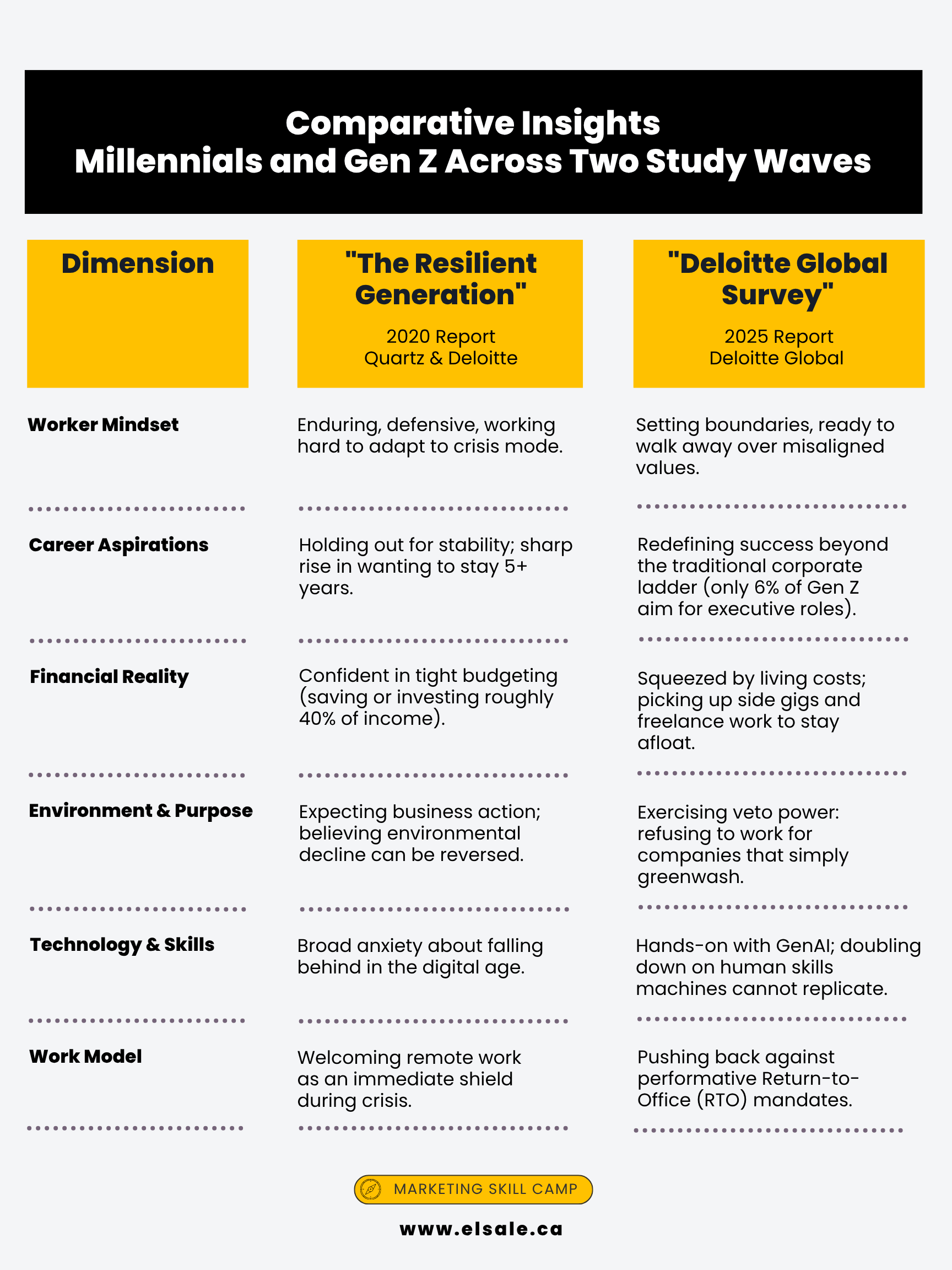
3. A Five-Year Comparison: 2020 vs. 2025
Another Perspective: The Line Between Healthy Boundaries and One-Way Expectations
On the ground, many managers find themselves in a real bind as employees increasingly push for flexibility, fairness, and new workplace norms shaped by years of disruption.
Leaders often struggle to balance valid calls for well-being and personal boundaries with the operational need to meet deadlines, honor commitments, and deliver actual business results. Both sides have legitimate points to make. That is precisely why the line between advocating for fairness and upholding mutual responsibility needs to be clearer than ever.
On mental health: Protecting emotional and psychological well-being is a genuine, fundamental need. Still, workplace empathy works best as a two-way street. It means employees stepping up to speak up early when workloads become unmanageable, sitting down to reset priorities together, rather than going silent and leaving the rest of the team hanging.
On flexibility: Autonomy over where and when work happens is a meaningful step forward for creative thinking. But that freedom only holds up over time when anchored by trust and personal accountability: staying responsive, keeping pace with team rhythms, and taking full ownership of the end results alongside colleagues.
On compensation and career growth: Wanting better pay and genuine advancement under today’s living costs is completely reasonable. At the same time, lasting financial growth for any individual has to tie back to the actual value delivered to the organization. When personal efforts directly drive the shared success of the business, conversations around fair compensation naturally find solid, common ground.
5 Strategic Lessons for Leaders
The modern social contract is not a one-way concession; it is an equal partnership. The organization builds a transparent environment that listens and empowers; the employee responds with reliability, personal discipline, and a commitment to delivering genuine value.
The shift in data between these two milestones is far more than a sociological trend. It is a clear reminder that top-down command and control no longer works in the modern world.
To build an organization with lasting vitality - where both the business and its people thrive together - leaders need to navigate five strategic lessons:
From surface extras to genuine financial security: With everyday costs climbing, free snacks and casual office extras simply do not solve the real problem. What employees actually need is clear pay structures, practical benefits, and a fair share in the company’s success. When the daily anxiety over making ends meet is met with tangible support, people finally have the mental room to bring their best, most creative thinking to the table.
From administrative oversight to genuine mentorship: As younger workers steer away from high-stress management seats, the answer is not tighter check-ins or stricter attendance. It comes down to how direct managers actually lead. Organizations need to free leaders from excessive reporting and red tape so they can step into true mentor roles: listening closely, patiently working through sticking points, and helping team members expand their own capabilities.
From the corporate ladder to a “Rubik’s cube” of skills: Forcing every strong specialist to step into people management ends up draining both sides. Forward-thinking companies build dual career tracks instead: one path for people leaders, and another for deep individual contributors, backed by equal recognition and comparable compensation. Giving team members the freedom to move across different projects and build diverse experience is one of the most human ways to keep talent around.
From attendance-checking offices to intentional gathering hubs: Hybrid work is not a reluctant compromise; it is an evolution in organizational trust. Rather than measuring commitment by the hours someone sits at a desk, turn the physical workplace into a destination for strategy sessions, creative exchanges, and community building - while respecting the quiet personal space people need for deep, focused work.
From public statements to operational ethics: Younger professionals build deep loyalty with organizations that have a clear purpose and follow through consistently. Commitments to social responsibility, environmental care, and inclusion cannot just live in polished annual reports; they have to guide daily business decisions. When an organization leads with honesty and integrity, it naturally draws in capable people who share those same values “for the long haul.”
The journey from 2020 to today carries a clear message: work is no longer the sole measure of a person’s life, but a meaningful piece of a full, well-rounded existence. This evolution is not an attack on organizations; it is a genuine invitation to build an employment relationship that is more equal and human-centered.
A lasting organization is never built on one-sided control or reactive demands, but takes root in mutual understanding and shared responsibility. When leaders listen closely, grant real autonomy, and run a purpose-driven business - and when team members meet them with commitment, discipline, and tangible value - we do more than simply retain talent. We shape a future of work that offers freedom, real connection, and lasting shared success.
About the Contributor
Elsa Le - Providing enterprise automation that enabling individuals to own and develop a parallel career with ease. Grounded in 25+ years of strategic collaboration with multinationals and SMEs, this space brings together perspectives on mindful living, zen leadership, and sustainable growth. Connect or discover more at elsale.ca hoặc linkedin.
References:
Quartz & Deloitte. The Resilient Generation. sponsored.qz.com/deloitte/the-resilient-generation
Deloitte Insights (2024). 2024 Gen Z and Millennial Survey: Living and working with purpose in a transforming world. deloitte.com/insights
Deloitte Global (2025). Deloitte 2025 Gen Z and Millennial Survey. Press Release. deloitte.com/global