

In the search for motivation and meaningful change, we often encounter a quiet truth: many organizations are not resisting change out of defiance, but because they’ve become “frozen.” These frozen states are not failures, they are signals.
When leaders learn to recognize them with compassion and clarity, they can begin the process of unfreezing, transforming, and refreezing with purpose.
What are the underlying factors contributing to this state of stagnation?
Frozen by Group Interests
When internal alliances become too entrenched, the organization may fragment. Resources and influence flow through informal networks rather than transparent systems, creating imbalance and legal risk.
In these environments, leaders must act with discernment and courage, gently creating new spaces for progressive teams to thrive. Over time, these spaces can shift the culture, reducing the influence of long-standing interest groups and restoring clarity and fairness.
Frozen by Capacity Limits
Even the most dedicated individuals can reach a point of exhaustion. When learning and development are neglected, people lose confidence in their ability to adapt. The pace of external change begins to feel overwhelming.
The remedy is not pressure, but renewal. Organizations must invest in human capacity, especially in times of uncertainty. When people regain understanding, they also regain confidence. And when confidence returns, the ice begins to melt.
Frozen by Vision and Mission Disorder
When leaders lose touch with the organization’s deeper purpose, direction becomes fragmented. Each person interprets the future differently, leading to confusion and mistrust.
What’s needed is not just strategy, but meaning. Vision and mission must be revisited regularly—not as slogans, but as shared commitments. When leaders reconnect with purpose, openness and adaptability follow. Change becomes not just possible, but welcomed.
The Mindful Leader as Transformer
A leader is not only a strategist, but a transformer, someone who guides systems through meaningful evolution. Their role begins with sensing where the organization has stalled, often at the intersection of emotional fatigue, structural rigidity, and cultural misalignment.
Transformation requires more than plans. It calls for presence, patience, and emotional intelligence. The leader must listen deeply, discern the hidden patterns, and design pathways that reconnect people to purpose.
And importantly, the leader is not outside the system but they are part of it. Their own growth, openness, and clarity become catalysts for collective renewal.
About Lewin’s Change Management Model
Lewin’s three-step model including Unfreeze, Change, Refreeze, offers a timeless, practical framework for guiding organizational transformation. It’s especially effective for leaders seeking clarity, simplicity, and psychological insight when navigating change
Leaders need to frame change as a psychological journey, not just a procedural shift. It’s especially helpful for small to mid-sized organizations or teams undergoing cultural or behavioral transformation.
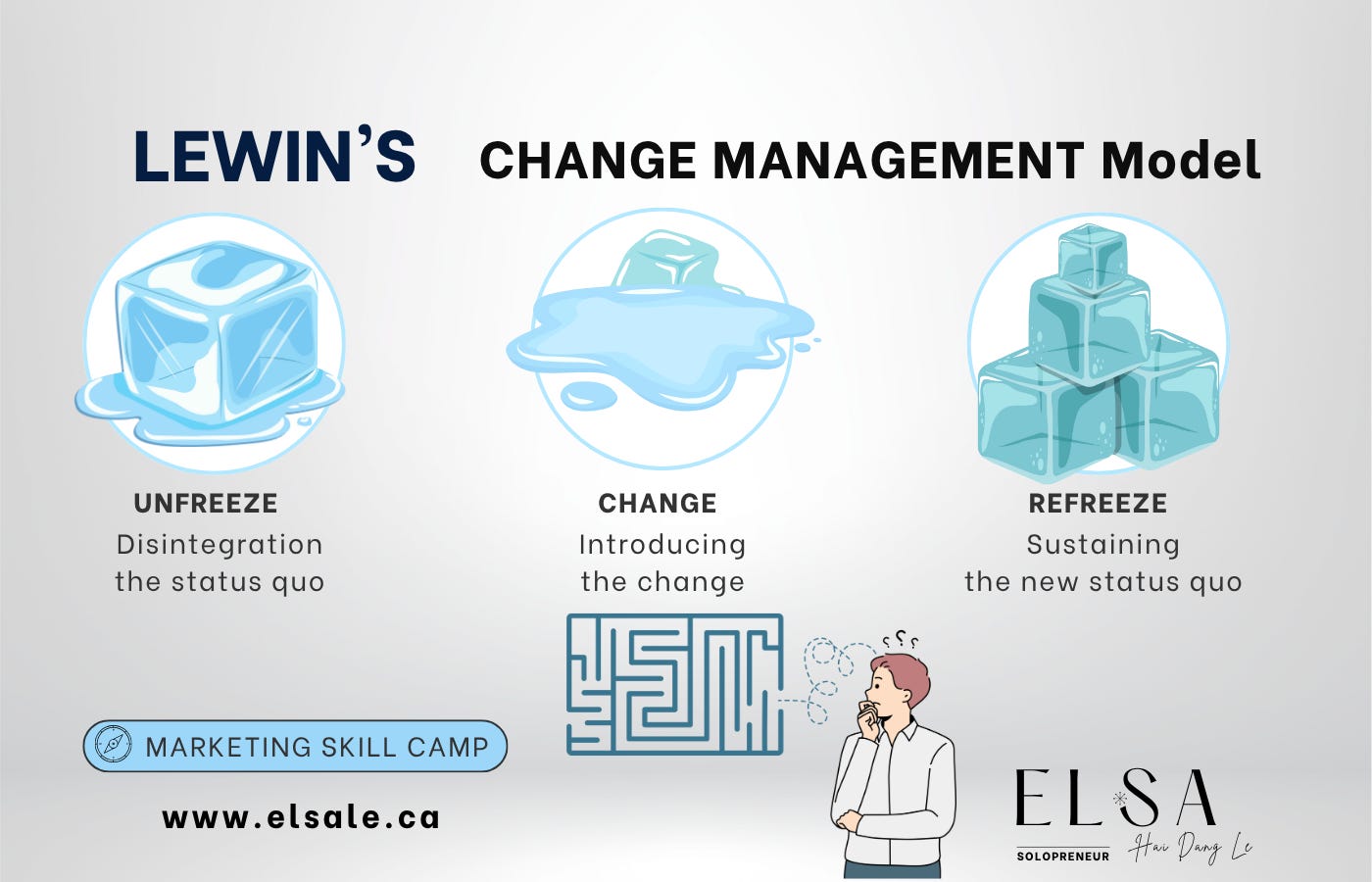
Unfreeze – Prepare the organization for change by challenging the status quo. This stage involves creating awareness of the need for change, addressing resistance, and building motivation.
Change – Implement the transformation. This is where new behaviors, processes, or structures are introduced. Support, communication, and training are critical.
Refreeze – Solidify the new state. Reinforce changes through policies, culture, and systems to ensure sustainability.
Pros of Lewin’s Model
Simplicity and clarity: Easy to communicate and understand across all levels of an organization.
Psychological grounding: Based on behavioral science, it addresses emotional resistance and group dynamics.
Structured process: Offers a step-by-step roadmap that’s adaptable to various contexts.
Cons of Lewin’s Modeln
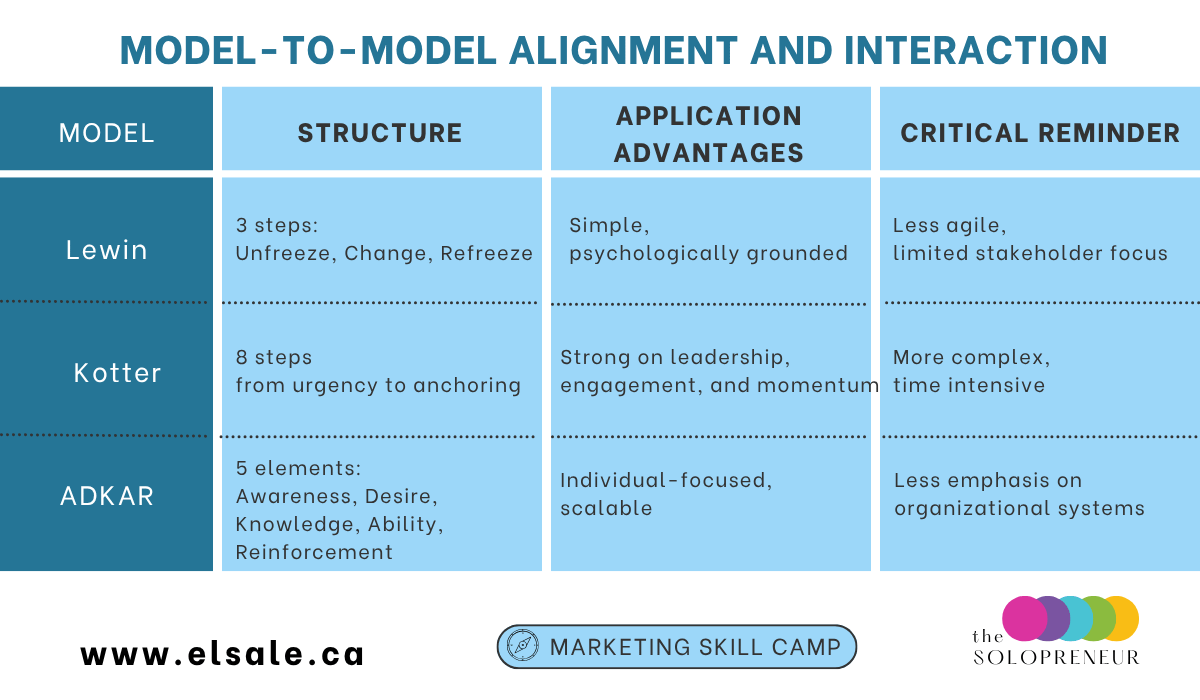
Too linear for complex change: In fast-paced or iterative environments, the rigid three-step structure may feel limited.
Refreeze stage may hinder agility: In today’s dynamic markets, “refreezing” can conflict with the need for continuous adaptation.
Limited focus on stakeholder engagement: Compared to newer models, Lewin’s framework doesn’t emphasize communication or leadership as strongly.
Lewin’s model is ideal for foundational change. Kotter’s suits large-scale transformations, while ADKAR excels in personal and team-level shifts.
When an organization ought to apply Lewin’s Change Management Model
Cultural shifts: Changing team values, leadership styles, or internal norms.
Process redesigns: Updating workflows, introducing new systems, or restructuring departments.
Crisis recovery: Navigating post-merger integration or rebuilding after setbacks.
It’s most effective when change is clearly defined, time-bound, and requires emotional buy-in.
Translating Lewin’s Theory into Actionable Change Strategies
Unfreeze: Help leaders craft a compelling narrative for change. Use data, stories, and empathy to build urgency.
Change: Guide teams through experimentation, feedback loops, and skill-building. Encourage visible leadership and peer support.
Refreeze: Reinforce new behaviors with recognition, updated policies, and ongoing coaching. Celebrate milestones to embed the change.
Initiating the Process: Key First Steps
In a state constrained by fragmented interest structures, the symptoms may include:
Teams resisting change to protect power, habits, or internal alliances.
Decisions shaped by an “us” versus “them” mindset.
In such cases, leaders must facilitate cross-departmental dialogue. Change should be reframed as a shared opportunity, ‘not a threat’, and storytelling should be used to shift the narrative from self-protection to collaboration. It’s like scattered icebergs that need a leader to help each group reconnect with the ocean of shared purpose.
In a state of stagnation caused by limitations in organizational and human capacity, the symptoms may include:
Individuals feeling overwhelmed, under-skilled, or unsupported.
Change perceived as “yet another burden” they cannot carry.
In such cases, leaders must conduct an honest assessment of capacity across skills, time, and emotional bandwidth. Each member should be offered micro-learning opportunities, peer support, and a phased implementation approach. Step by step, the leader steers the process to normalize vulnerability and growth. It’s like a frozen pipe: pressure builds until it bursts, what’s needed is a gentle warming of the system.
In a state of disorientation caused by misaligned vision and mission, the symptoms may include:
Ambiguity around goals, direction, or values.
A lack of a “North Star” to guide decision-making.
In such moments, leaders must revisit and realign the organization’s vision and mission. Reflective exercises are a powerful way to reconnect with meaning. At the same time, leaders translate abstract aspirations into daily actions. Like a compass spinning in the fog, clarity dissolves fear.
Lewin’s model is a powerful starting point, especially when paired with modern tools and emotional intelligence. It helps leaders slow down, reflect, and guide change with intention. For organizations seeking clarity and commitment, it remains a timeless ally.
