

MILESTONES — LITTLE SIGNS OF BIG GROWTH
Fluency doesn’t happen overnight.
It grows quietly — in the words you dare to say, the moments you understand without effort, and the joy of realizing: “I just did that in English.”
Who This Roadmap Is For
This English Roadmap is designed for learners from A2 to B2 levels: those who already know the basics and now want to live the language: to speak naturally, listen confidently, and grow a voice that feels authentic.
If you’re at A1 (true beginner): you may need a little more foundational work first: learning the alphabet, phonics, and basic survival phrases. Once you can hold simple conversations, you’re ready to begin this roadmap.
If you’re at C1–C2 (advanced or near-native): you might find this plan too gentle. Instead, focus on higher-level goals like debate, storytelling, creative writing, or academic fluency to polish your tone and expression.
Read more: Finding the Path That Fits You: Decode English Proficiency Tests
Before You Begin — Know Your Why
Every roadmap starts with a reason.
Ask yourself: Why do I want to learn English? For work, study, travel or simply to express yourself better?
When your purpose is clear, learning feels lighter, progress feels real, and every effort finds its meaning.
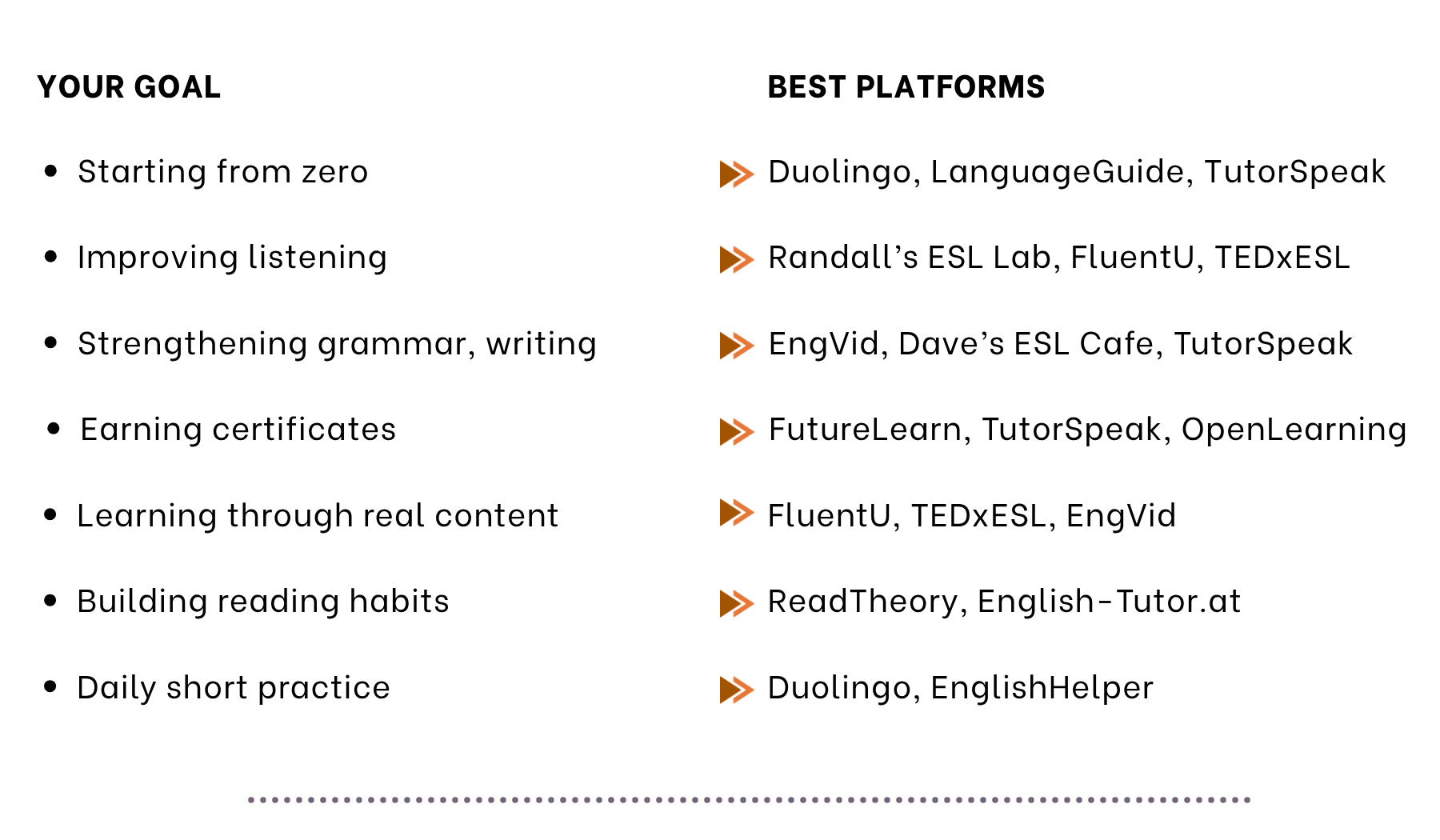
HOW DOES THIS ROADMAP BENEFIT YOU?
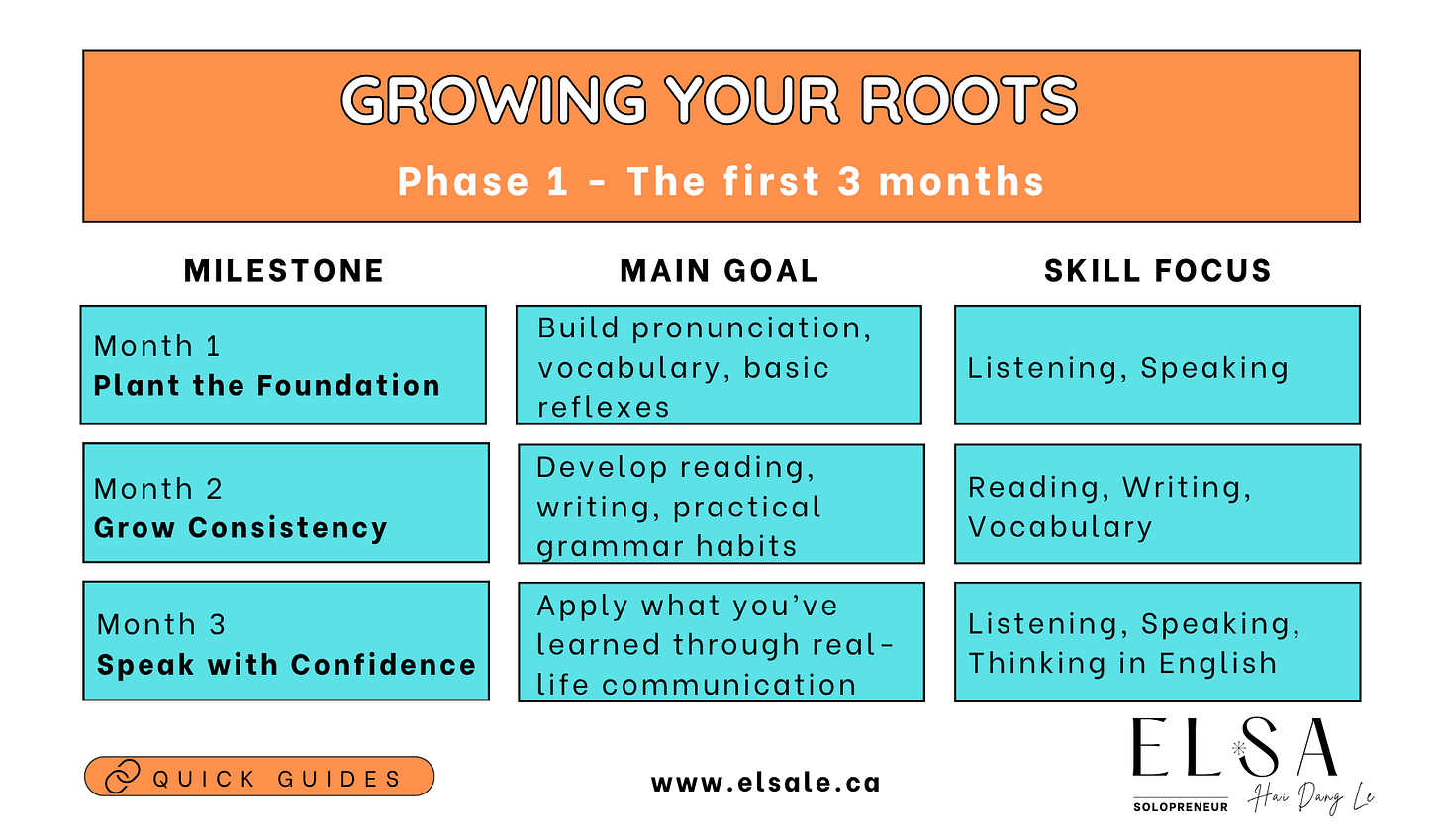
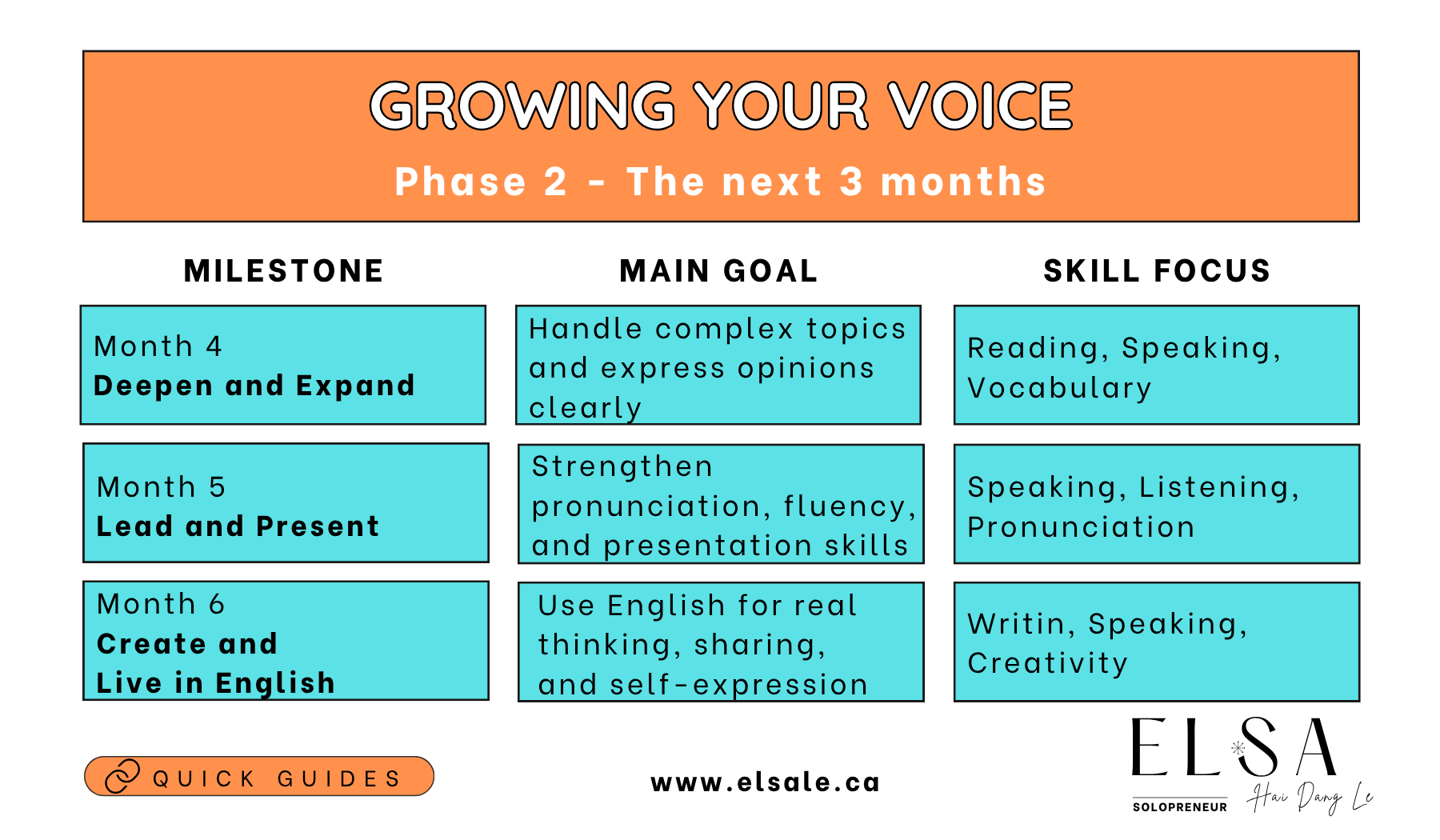
THE RHYTHM OF YOUR ENGLISH JOURNEY
Every journey has its rhythm.
The first three months root you in habit and courage where English becomes part of your day.
The next three let you bloom in fluency where you start to think, feel, and live in English.
Step by step, your voice grows grounded, confident, and real.
PLATFORMS AND TOOLS
Learning English doesn’t have to be expensive. The good news is, it has never been easier or more accessible than it is today. There are countless free, high-quality, and trustworthy resources. All you need is a phone or a computer. The Internet is an ocean of knowledge; you just need to find the right tools that fit your goals.
Read more: Your English Journey: Learn Freely, Grow Steadily with Free and Powerful Resources
Daily Habit Formula
10 min reading + 10 min listening + 10 min speaking/journaling = 30 min of living English daily.
Stay curious. Stay kind to your progress.
Fluency is not a finish line. It’s a way of living your thoughts out loud.
YOUR FIRST BREAKTHROUGH AFTER 3 MONTHS
Listening: You understand about 70% of everyday content. You catch the main idea when listening to slow conversations or videos.
Speaking: You can introduce yourself, describe your day, and share simple opinions without hesitation.
Reading: You can read short articles or social posts without translating every word.
Writing: You can write short, clear paragraphs (5–10 sentences) that express your ideas naturally.
Habit: English becomes part of your daily life, the fear fades, and curiosity grows.
WHAT YOU’LL GAIN AFTER 6 MONTHS
Listening: You understand 80–90% of everyday conversations, podcasts, and videos even when speakers talk fast or use different accents.
Speaking: You express thoughts clearly, share opinions with confidence, and hold natural conversations without translating in your head.
Reading: You read news, blogs, and short stories smoothly, catching tone, humor, and emotion.
Writing: You write clear, thoughtful paragraphs from reflections to short essays or messages.
Habit: English becomes part of your rhythm, not a subject to study, but a language you live in.


MONTH 1 – Rebuild & Reconnect (Weeks 1–4)
Goal: Strengthen core grammar, pronunciation, and everyday confidence.
Week 1: Restart with clarity, review key grammar and listening basics
Tools and platforms: BBC Learning English, VOA Learning
Habit and practice: 15 min everyday, slow listening and short diary writing
Week 2: Sound it out, focus on pronunciation
Tools and platforms: Duolingo
Habit and practice: Shadow 5 min everyday and record 1 paragraph aloud
Week 3: Grammar in action
Tools and platforms: British Council LearnEnglish, Quizlet
Habit and practice: Practice 3 mini-games everyday and build 1 grammar note sheet
Week 4: Everyday listening
Tools and platforms: TED-Ed, EngVid
Habit and practice: Watch 1 short clip/day and note 5 useful phrases
MONTH 2 – Grow & Interact (Weeks 5–8)
Goal: Move from understanding to expression.
Week 5: Vocabulary in context
Tools and platforms: Memrise, BBC 6-Minute English
Habit and practice: Learn 10 new words everyday, use 3 in sentences
Week 6: Speaking and connection
Tools and platforms: HiNative, TutorSpeak
Habit and practice: Summarize 1 lesson aloud each day
Week 7: Think in English
Tools and platforms: Coursera – Improving Communication Skills, Podcast (All Ears English, Luke’s English Podcast)
Habit and practice: Summarize 1 lesson aloud every day
Week 8: Active reading and discussion
Tools and platforms: English‑Tutor.at, ReadTheory, ShareAmerica
Habit and practice: Read 1 article everyday and paraphrase in 3 sentences
MONTH 3 – Speak, Reflect & Flourish (Weeks 9–12)
Goal: Strengthen fluency, rhythm, and storytelling.
Week 9: Storytelling and self-expression
Tools and platforms: TED Talks, TED Ed
Habit and practice: Tell 1 personal story every week (2 min recording)
Week 10: Accents and cultural tones
Tools and platforms: Elllo.org, BBC Interviews
Habit and practice: Listen to 3 accents every week, imitate tone & rhythm
Week 11: Confidence in real use
Tools and platforms: FutureLearn – English for the Workplace
Habit and practice: Participate in 1 discussion every week
Week 12: Reflection and milestone
Tools and platforms: Nhật ký cá nhân / video vlog
Habit and practice: Record a self-interview about your journey
MONTH 4 – Deepen & Diversify (Weeks 13–16)
Goal: Broaden topics, handle abstract ideas, expand comfort zone.
Week 13: Debate and opinion
Tools and platforms: Coursera – English for Career Development, BBC Radio 4
Habit and practice: Write 1 opinion paragraph every week, discuss online
Week 14: Writing with clarity
Tools and platforms: LanguageGuide.org, grammary, hemingway app
Habit and practice: Edit 2 short texts every week, focus on tone & flow
Week 15: Reading beyond comfort
Tools and platforms: ReadTheory, ShareAmerica, Medium
Habit and practice: Read 3 articles every week, summarize key insight
Week 16: Emotional fluency
Tools and platforms: TED Talks, TED Ed
Habit and practice: Reflect on 1 motivational talk every week, retell it in your own words
MONTH 5 – Express & Lead (Weeks 17–20)
Goal: Speak with confidence, lead conversations, and refine pronunciation.
Week 17: Public speaking basics
Tools and platforms: TED-Ed Student Talks, Toastmasters Online
Habit and practice: Give 1 mini-presentation every week
Week 18: Advanced listening
Tools and platforms: Podcast: Hidden Brain, The Diary of a CEO
Habit and practice: Take notes on tone, idioms, emotion
Week 19: Accent fine-tuning
Tools and platforms: Duolingo, Elsa Speak
Habit and practice: Compare your speech to 2 natives every week
Week 20: Collaborative speaking
Tools and platforms: Meetup Language Cafés, Zoom Language Exchanges, Tandem
Habit and practice: Host or join 1 conversation session every week
MONTH 6 – Create & Thrive (Weeks 21–24)
Goal: Integrate English fully into daily life — use it as a tool to think, feel, and create.
Week 21: Creative writing and storytelling
Tools and platforms: Medium, Substack, Facebook
Habit and practice: Publish 1 short piece every week
Week 22: Teach to master
Tools and platforms: Meetup Language Cafés, Zoom Language Exchanges, Tandem , HelloTalk Tutor Mode, Speaky Groups
Habit and practice: Explain grammar or words to others
Week 23: Real-world immersion
Tools and platforms: edX, FutureLearn
Habit and practice: Study a topic entirely in English
Week 24: Celebrate fluency
Tools and platforms: Medium, Substack, Facebook
Habit and practice: Create your English “capstone” project – your voice, your story like Self-reflection video, Podcast collaboration, Online interview
But learning English is not something that happens just because you study hard today and expect to be fluent tomorrow. It’s like taking care of a plant you have to water it every day, even just a little. Fifteen minutes of podcast listening while cooking, a few lines of a journal entry in English, or a short video before bed, those small things, done daily, are what truly make a difference.
Beyond the Roadmap — Because Growth Expands Forever
Fluency doesn’t end when the roadmap does. It simply changes shape.
After months of steady practice, your English is no longer just a skill but a part of who you are.
Now comes the exciting part: expanding it beyond daily conversations, into the world of opportunities that English can open.
Whether you dream of earning a global certificate, working abroad, or simply deepening your voice in another language. This next stage is for you.
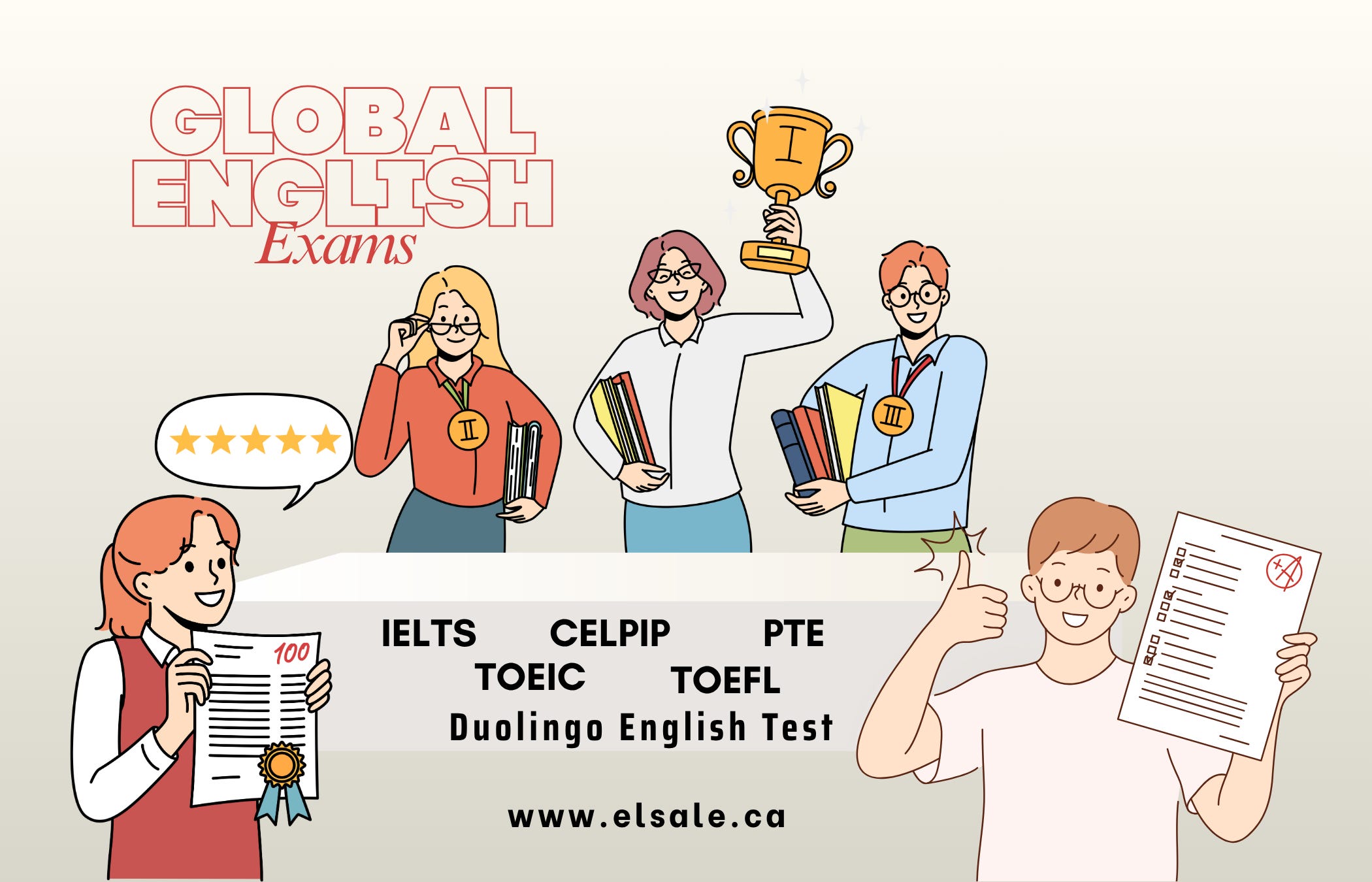
Here are some free, trusted platforms to guide your next leap through practical tools that keep the joy of learning alive while helping you reach official certifications like IELTS, CELPIP, TOEFL, TOEIC, and PTE.
Because every step you’ve taken so far isn’t an ending. It’s the beginning of your global story.
Free English Resources for Global Exams
Learn Smart, Aim High
IELTS — LEARN THE WORLD’S TEST OF COMMUNICATION
Best free sources:
IELTS.org Practice Tests: official sample questions, Free sample tests and study tips
IELTS Liz (YouTube): real test strategies, writing templates, and speaking tips. Bite-sized lessons that feel like coaching, not studying.
IELTS Simon: Exam Skills – Authentic listening and grammar review
BBC Learning English - Exam Skills: daily audio & videos for vocabulary, grammar, and pronunciation. Natural English, authentic listening and grammar review, clear examples, and confidence boosters for test day.
YouTube IELTS Advantage / E2 IELTS: High-quality lessons on speaking & writing.
FutureLearn – Understanding IELTS (by British Council) – 100% free structured course and friendly. Each skill is broken down with practical tips and sample tasks.
Tip: Combine IELTS listening with Netflix subtitles in English because your ear learns faster when your heart enjoys it.
CELPIP — ENGLILSH FOR REALIFE IN CANADA
Best free sources:
CELPIP.ca Free Practice Test: official sample questions by Paragon Testing, free samples and test-day tips, updated regularly.
CELPIP YouTube Channel: examiner advice & real test examples.
YouTube: Paragon Testing / HZad Education – Speaking and writing demo answers that show exactly what high scores sound like.
Grammarly Free Version: practice writing emails and daily English exactly what CELPIP tests.
Reddit.com: r/CELPIP – Real test experiences, real learner tips, test-day experiences, and motivation from others on the same path (peer feedback).
Listenwise or CBC Podcasts – Real Canadian English practice.
Tip: Practice describing real-life moments - your commute, a workplace challenge, or a family event. That’s CELPIP in.
TOEFL — ACADEMIC ENGLISH FOR REAL THINKERS
Best free sources:
ETS TOEFL Practice Tests: official mock tests from ETS, free sample listening & reading papers, learn directly from the test creators, step by step.
Magoosh TOEFL YouTube Channel: clear lessons on writing & speaking structure, smart strategies, vocabulary lists, and motivation you can read anywhere.
TED Talks: real-world listening for advanced vocabulary and critical ideas.
ExamEnglish.com: Free grammar and TOEIC-style quizzes.
YouTube: TOEIC Official / EngVid TOEI: Listening & vocabulary practice.
BBC Learning English – Business English Section: Ideal for TOEIC context practice.
edX – TOEFL Test Preparation (by ETS): Free, self-paced course from the test maker to build skills across all sections.
TestGlider: Mock tests with automated scoring for speaking and writing to simulate real exam conditions.
TOEIC —ENGLISH FOR WORK AND CONFIDENCE
Best free sources:
ETS TOEIC SAMPLE TESTS: official question sets.
ETS Global – TOEIC Practice Test: Free sample listening & reading papers.
ExamEnglish.com: Free grammar and TOEIC-style quizzes to sharpen your instincts.
YouTube TOEIC Official / EngVid TOEIC: Real istening & vocabulary in use.
TestEnglish.com TOEIC Practice: short daily quizzes for real business contexts.
VOA Learning English – Business Series: great for listening and workplace vocabulary.
BBC Learning English – Business English Section: Ideal for TOEIC context practice, build confidence for work and meetings.
Tip: Listen to real business meetings on YouTube — even 10 minutes daily can train your tone and confidence.
PTE — SMART, FAST, MODERN
Best free sources:
PearsonPTE.com (Official Practice App & Mock Tests): Free question bank and free speaking feedback from real tutors; upgrade optional.
E2Language YouTube Channel: expert tips and full tutorials, walkthroughs of each task with tips that save time under pressure.
SpeechTexter: free online speech-to-text tool to practice speaking.
EnglishScore Tutors (by British Council): Free speaking feedback (optional upgrade).
PTE Tutorials Website: Practice questions and writing templates for real exam settings.
Tip: PTE rewards natural fluency; speak as if you’re telling a story, not reading a script.
DUOINGO ENGLISH TEST — FRIENDLY AND FAST
Best free sources:
Duolingo English Test Official Site: free practice test and question examples.
EngVid: hundreds of free English lessons by level.
Duolingo YouTube Channel: guides on scoring, structure, and preparation.
Tip: Duolingo tests adaptability, practice quick reading, fast thinking, and short, clear writing every day.
A gentle reminder: The best test prep doesn’t start with a book. Iit starts with a mindset.
You don’t need to have everything, just start with something.
Set a small goal each week: one listening practice, one short essay, one speaking session.
Little by little, you’ll realize English is no longer something you “study”. It’s something you live.