To allow AI to "crawl seamlessly" through your site without confusion and include you in its recommendation system, you need a Google Business Profile, a website optimized for both SEO and AEO, and a strong digital footprint across social media platform.
AEO (Answer Engine Optimization) is the process of optimizing content so that AI-powered answer engines (ChatGPT, Google Gemini, Perplexity) select your website as the primary, most authoritative source for their responses.
Principles of AEO Operation
Unlike SEO (which relies on page-ranking algorithms), AEO operates on a “Retrieve - Understand - Synthesize” model. The process involves three key steps:
Indexing for Intent: AI bots (such as GPT-bot) crawl websites not just to find keywords, but to understand the user’s intent. It analyzes structured data (Schema) to distinguish between questions, answers, pricing, and technical specifications.
Authority & E-A-T Evaluation: When thousands of websites cover the same topic, AI selects the most authoritative source. The core principle here is “Consensus”: If your information aligns with other reputable sources and is presented by a verified expert, the AI will prioritize and trust your content.
Extraction & Summarization: Large Language Models (LLMs) “pluck” short, concise text segments typically in list format or 40-60 word definitions to assemble the final answer provided to the user.
Can AEO Fully Replace SEO?
The short answer is: No, AEO does not replace SEO. Instead, they share a symbiotic relationship. Think of SEO as the "foundation" and AEO as the "advanced layer" designed to adapt to modern user behavior.
AEO is the evolution of SEO in the era of Artificial Intelligence. You don't have to abandon one to choose the other. If you optimize well for AEO, your SEO score will naturally improve as both share a common goal: To provide the best and most accessible value to the user.
1. SEO for “Depth,” AEO for “Speed”
AEO: Caters to quick and simple queries (e.g., “How much is a flight to Canada?” or “What is the TA UP model?”). AI will extract a concise snippet to provide an immediate answer.
SEO: Caters to in-depth research, comparisons, experiential reading, or entertainment (e.g., “Comprehensive Guide to Immigrating to Canada” or “Detailed Reviews of Online Business Courses”). This type of content is too extensive for AI to summarize fully without losing its original value.
2. Traffic Still Resides in SEO
The AEO Challenge (Zero-click): When AI provides an answer that is “too good,” users may no longer feel the need to click on your website. While this is beneficial for brand awareness, it can be detrimental to conversions if you need users to visit your site to fill out a form or make a purchase.
The Value of SEO: SEO guides users through the Customer Journey. To successfully close a sale, you still need users to land on your landing page, watch your videos, and build trust in your system—results that a brief ChatGPT response simply cannot deliver.
3. SEO Provides the “Power” for AEO
The operating principle of AI is based on existing data. Without SEO (optimizing site structure, page speed, backlinks, and content credibility), AI tools will:
Fail to find your content to cite it.
Lack trust in your content because the website lacks Authority.
AEO is an excellent “peak,” but it can only shine when you have a solid SEO “foundation” in place.
IMPORTANT TIPS OF AEO:
Customers do not only search exclusively through traditional search engines like Google Search, Edge, or Ecosia but also they are increasingly searching for products and services via AI tools. They want instant answers, and you need ChatGPT, Gemini, Copilot, and Grok to recommend your website as the #1 or #2 choice.
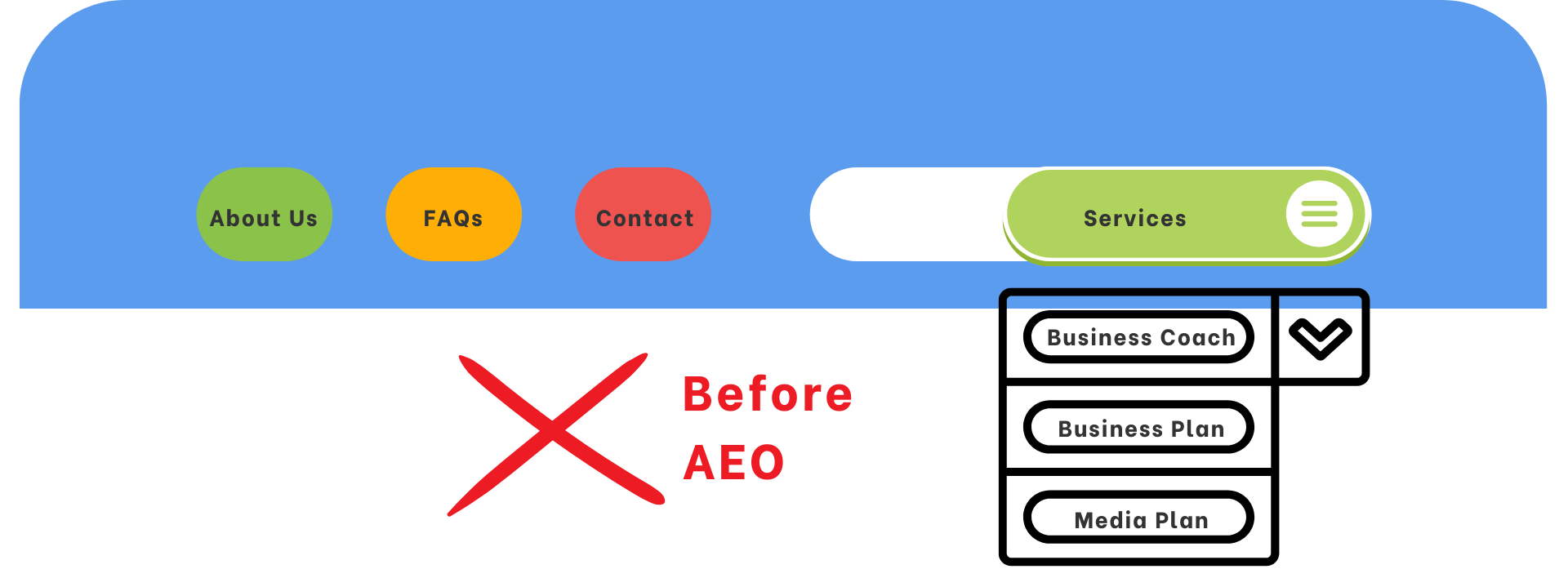
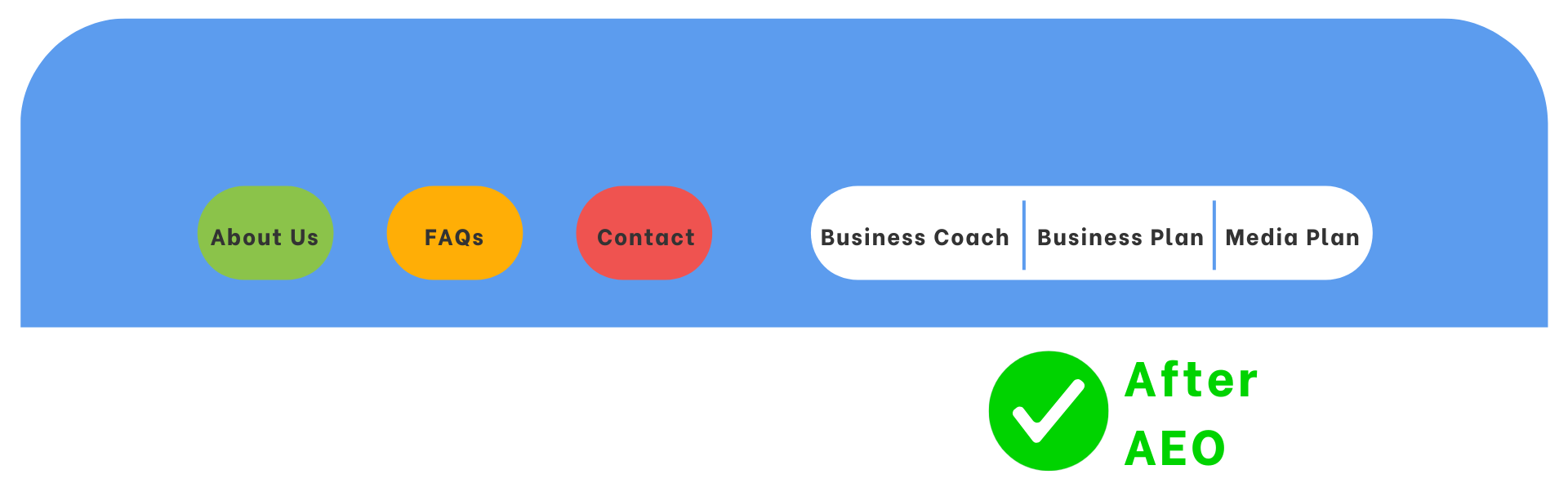
Here is a special tip for SMEs (Small and Medium Enterprise): To help AI "catch the signal" of your website, instead of bundling various product sub-tabs into a single main tab, you should separate each product into its own primary tab (as shown in the illustration). With this layout, AI can rapidly discover your content, ensuring your website appears in the top 1 or 2 spots when the AI responds to customers.